
April 2026 Market Outlook
The first quarter of 2026 has been extraordinary in several ways. Yet at the same time, it has also been a bit like watching paint dry from a broad market return standpoint. Of course, the big story is that Q1 was bookended by significant US military excursions against two oil-rich adversaries. In decades past, we would expect to be writing about significant market volatility, double-digit corrections driven by spiking oil prices, and consensus predictions of an imminent global recession.
In fact, last year’s “tariff tantrum” saw the S&P 500 fall nearly 19% from February 19th through April 8th. By contrast, top-to-bottom, thus far this year, the S&P 500 dropped 7.82% from February 27th through the end of March. Of course, we realize this ongoing conflict is not over—and we are not declaring an end to market volatility!
Instead, we report (at this writing) that the S&P 500 is up 4.47% on a year-to-date basis (yes, a new all-time high)—with most of this upside having occurred since the February 28th actions against Iran began. Traditional “safe-haven” assets like the US 10-year Treasury are little changed from their yields at the beginning of the year. And while economic concerns have been raised due to increased oil prices and choked-off supply, there has yet to be a cacophony of recession predictions (again, as we write). The IMF and most analysts have hedged their bets, citing the length of the conflict as the deciding factor (an unknowable variable at this point, but this certainly rings true to us). Gold, too, is little changed on a year-to-date basis (+0.85%), but well off its January 29th highs. In recent days, it has been announced that the Strait of Hormuz—a renowned bottleneck for the world’s energy supply—has been reopened. Color us skeptical that this settles anything from a geopolitical standpoint. This war has been going on for nearly 50 years. We doubt it ends in negotiation.
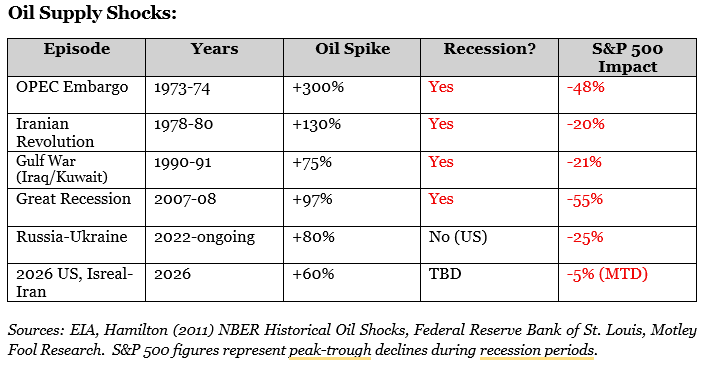
What has changed from past oil shocks here in the US is that we are now net exporters of oil and gas and are less susceptible to the immediate effects of a supply shock. We think this is reflected in the US market reactions from February 28th versus most other major indices.
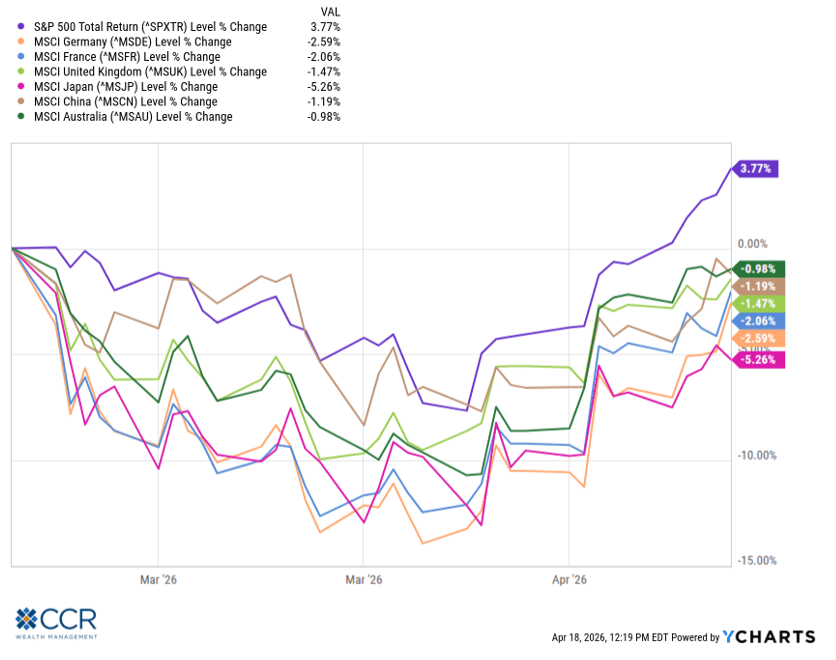
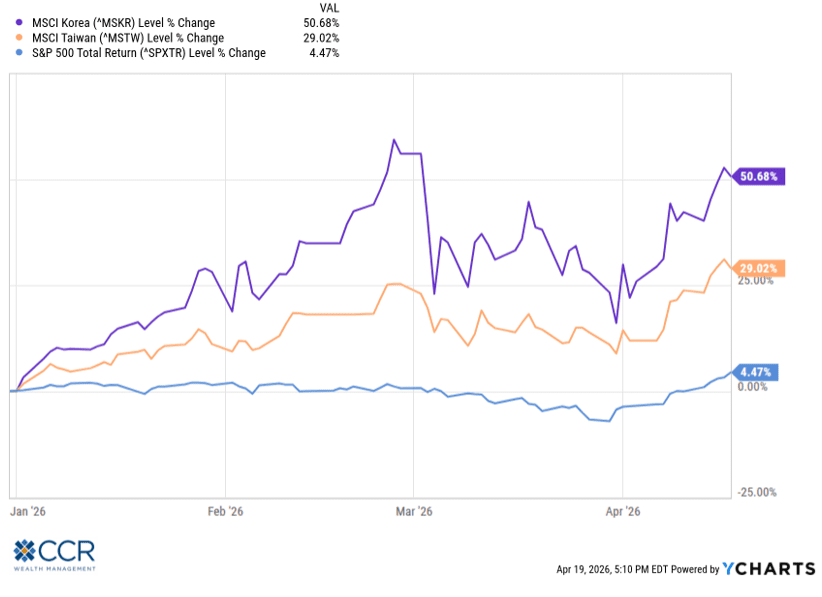
Notably, three of these country indices still outperform the US on a YTD and 6-month basis, as does the MSCI Emerging markets index (by a wide margin), illustrating that while much of the rest of the world is more dependent on Middle Eastern oil than the US, global investors remain optimistic enough (for now) that recession probabilities embedded as stock-price components remain low. While the spot price of oil spiked over 60% in March, the Futures curve for crude oil has remained downward sloping, with traders expecting to pay in the low $70’s for a barrel of crude by December. This is the market’s gauge of how things will play out—call it the Wisdom of Crowds theory—and could explain the thus-far muted responses in equity markets around the globe, at least compared to historical precedents. While the US is more insulated from the immediate effects of oil shocks, what impacts our trading partners around the world will, of course, circle back to us eventually. The geopolitical news cycle has been volatile, and we expect it to remain so. While we are not geostrategic analysts, we think investors should be skeptical of cease-fire “agreements” made with avowed and ideological enemies, proclamations that the war is “over”, and should rather rely on sufficient portfolio diversification across asset classes, geographies, and sectors to help insulate against potential negative scenarios ahead.
We must not risk oversimplifying this conflict—while there are echoes of the past in terms of oil shocks (Yom Kippur war 1973, Tanker Wars of the 1980’s, Gulf War, etc), it is important to understand that the world is a different place today. For one, economies around the world are much more interlinked than they were decades ago. Shocks to one economy or region are more quickly transmitted to others today. Technology has also advanced. While the US military has clearly capitalized on these advancements, we are also dealing with advancements in our adversaries’ tactics: drone swarms, missile threats that threaten not only ships seeking transit of the Hormuz Strait, but also other important players in the region, more aligned with the global economy. And the oil and natural gas exported from the Gulf region doesn’t simply end up in transportation costs, though “price at the pump” is the most often cited indicator of rising prices. Oil and natural gas are critical components in the manufacture of clothing, fertilizer, and helium (essential to the manufacture of semiconductors), among many other uses.
Diversification should also not be oversimplified into “US” or “non-US” categories either. Net exporters of energy around the world stand to gain the longer this conflict lasts (the MSCI Brazil index is up 29.56% year to date). Economies dependent on energy imports—especially if dependent on Gulf oil—are at risk. Economic diversification will also be a factor. South Korea, while economically dependent on Gulf oil, is a much more diversified economy than, say, Taiwan. Notably, both vulnerable economies are reflected by stock markets far ahead of the US year to date, regardless of events surrounding the Straits of Hormuz. Looking into emerging markets as a diversifier through this lens could provide portfolio resiliency.
OK, mental exercise/thought experiment here: Take away the Iran issue, and where would we be?
Recall, as implied in our opening remarks, that the US equity markets were not exactly “lighting it up” by February 27th, the day before Iran hostilities commenced. The S&P 500 was barely in the black (+0.68%), while the tech-laden NASDAQ 100 index was down 1.15%. Not terrible—but unremarkable. In fact, this “stall” in the markets began at the end of October last year. Significant bifurcation within sectors was (and remains) in effect, with investors exhibiting some likely prudent skepticism about AI narratives, including spending intentions, growing debt levels, business models, energy supply requirements, industry impacts, and chip shortages/compute inadequacies, just to name a few.
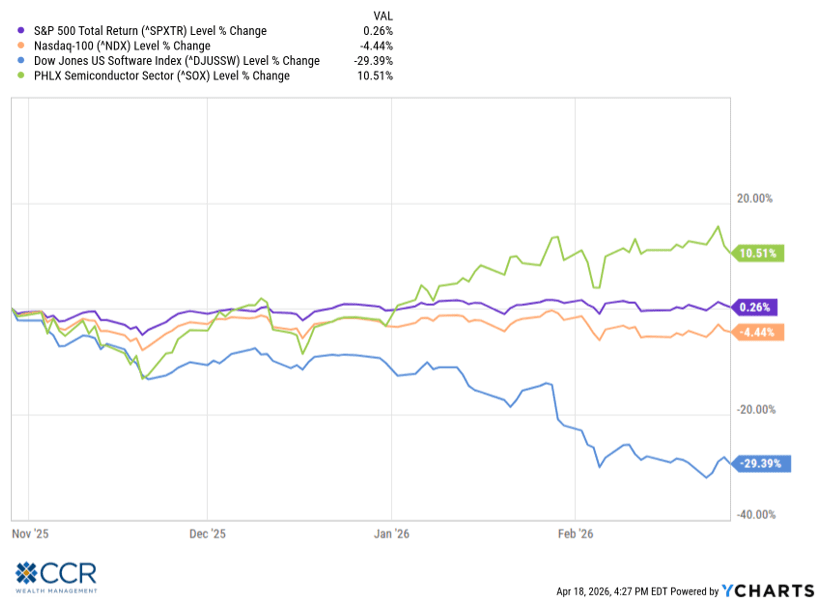
A glaring example has been the angst surrounding software stocks and the Citrini Report (February 22), which highlighted how Anthropic’s Claude AI system could possibly make the software engineer obsolete—along with great swaths of the sector itself. This was more of a thought-piece than a credible analysis—but given the market’s reaction (SELL ALL SOFTWARE NOW!), it’s clear that investors have developed an unease with AI narratives and assumptions. Software stocks account for ~30% of the Information Technology sector of the S&P 500 and represent 11%-15% of the broader index. Conversely, semiconductor stocks represent ~25% of the Information Technology sector, and ~12% of the broader market, and have been doing just swimmingly in comparison. The result is flattish performances of broader markets and sectors, with plenty of “roiling” going on under the hood.
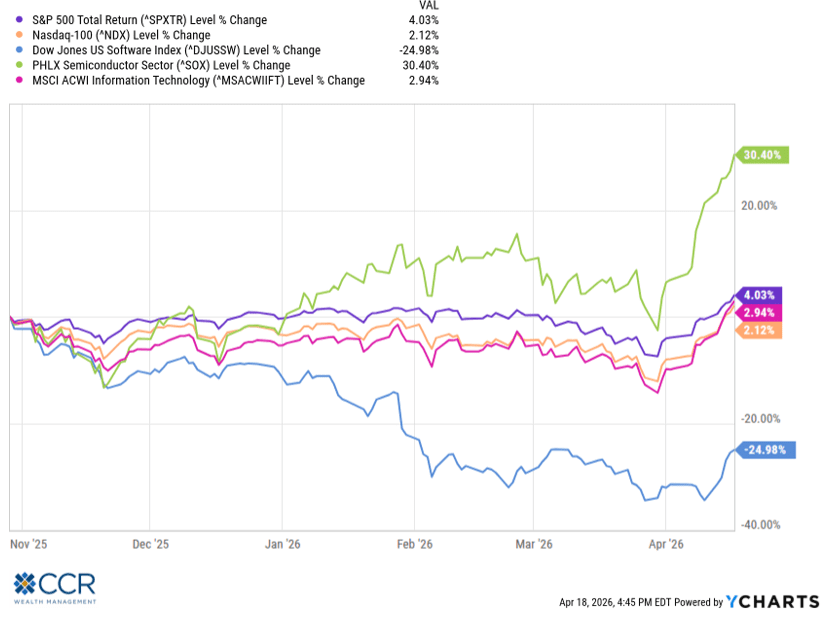
Having confidence in directional trends requires more study, though. When we add a few layers of technical analysis in (and we do—but we’ll spare you the details here), we find quite often that positively trending semiconductors become extremely “overbought” on a relative strength basis (buyer’s frenzy), making further upside unlikely, and a mean-reversion selloff highly probable. Conversely—not all software will be cannibalized by AI—and many stocks have become “oversold,” implying the same mean reversion upside probability and opportunity.
This is not confined to tech. Looking at Financial Services, we see a big disparity in major components of the sector: banking, asset management, and insurance. Healthcare includes a healthy pharmaceutical stock group along with a more challenging Life Sciences industry.
The point we want to extract from this information is that it is apparent to us when we consider “market internals” (breadth, relative strength, Put/Call ratios, % new highs, % above 20-day, 50-day moving averages) that investors have become extremely short-term in focus.
The markets are roiling and churning below the surface. This is a great environment for an active trader. On the other hand, if you are an indexer, you’re watching grass grow. There are, however, some very strong conditions worth noting—short-term though they may be.
- As we write (4/18/26), the S&P 500 index is overbought. (This may not be the case by the time this publishes—but it would require a significant upward thrust in all components in the index to change this, or a significant decline in the index level itself).
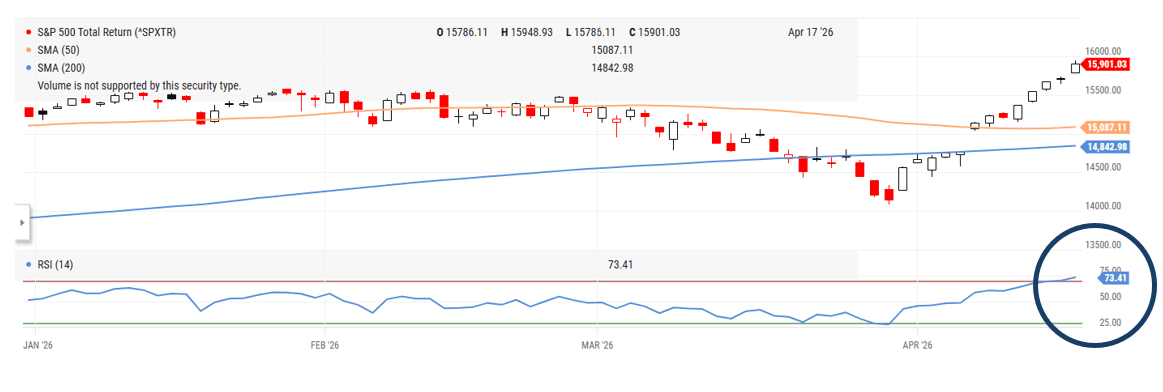
- The percentage of stocks above their 20-day moving average (as of 4/18) is 80%—yet the index (S&P 500) is up 12.40% since the end of March. This suggests less than ideal participation in an index that just made a new high. 90%>20-day MA would change our minds.
- Return differentials in the Russell 1000 Value Index (energy, utilities, healthcare, basic materials, etc) have significantly overtaken returns in the Russell 1000 Growth Index (tech, tech, tech). Among the mental rolodex of corny Wall Street sayings in our head is included “the trend is your friend”. The R1000 Value index trend is solidly bullish. The R1000 Growth Index trend is bearish—having gone through a “dark cross” (DC) on March 24 (50-day moving average crosses below 200-day moving average). Note, both are “overbought”—but less so with value versus growth.
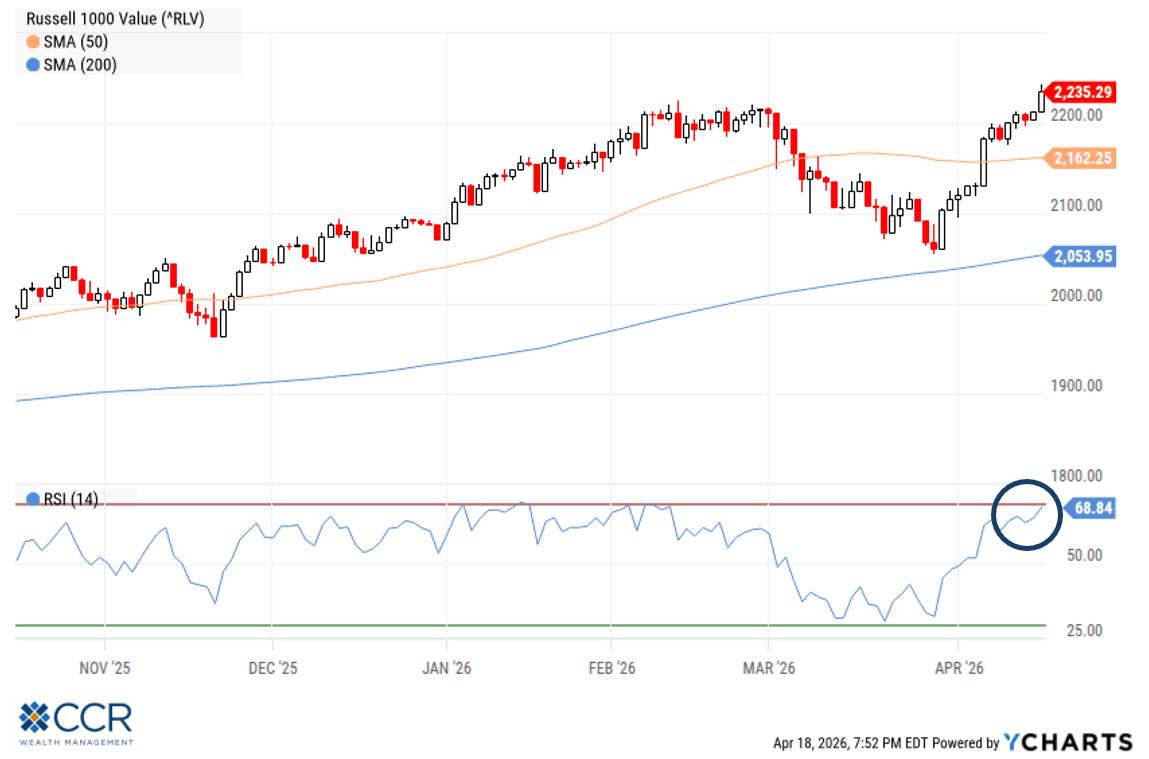
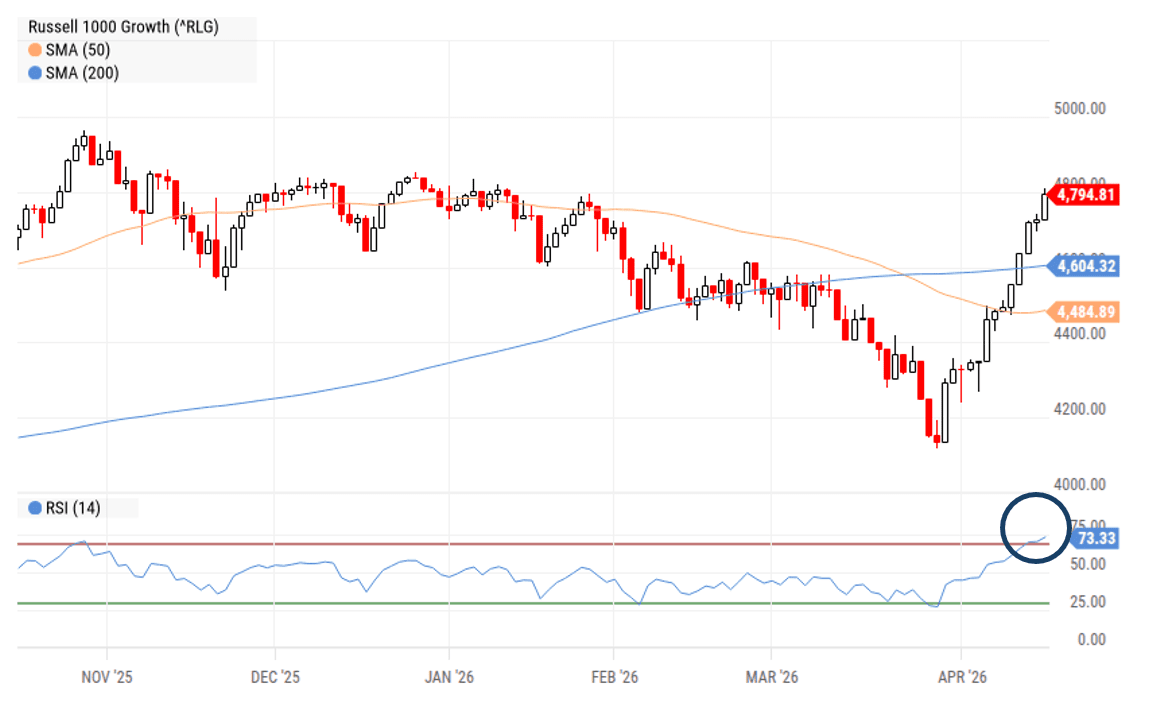
As we said, our sense is that “short-termism” has firmly controlled this market for the last 3-6 months, so we trust the technicals more in “reading the tea leaves”.
Lastly—as we are focused on market structure in this Outlook—it is important to know that often it is the bond markets which tell us what we want to know about the future of the equity markets.
“Private Credit” has made its way into the portfolios of many individual investors of late. We would already be retired if we had a dime for every e-mail or phone solicitation from a Wall Street firm letting us know (or attempting to) what has been “getting traction” in the marketplace (hint: it’s a private credit product pitch). The inference being, the more investors are buying something (at the recommendation of their financial advisors), the more legitimate it must be. CCR Wealth Management has always put a premium on our clients’ liquidity, and held a skeptical view of Wall Street trends, and we are happy to report our models have remained completely free of private credit investment “products”. But concerns within the category have been elevated alongside concerns about the software industry. Many investors are now, unfortunately, discovering the downside of illiquid investment products, as many of the largest private credit players have closed their doors to redemptions.
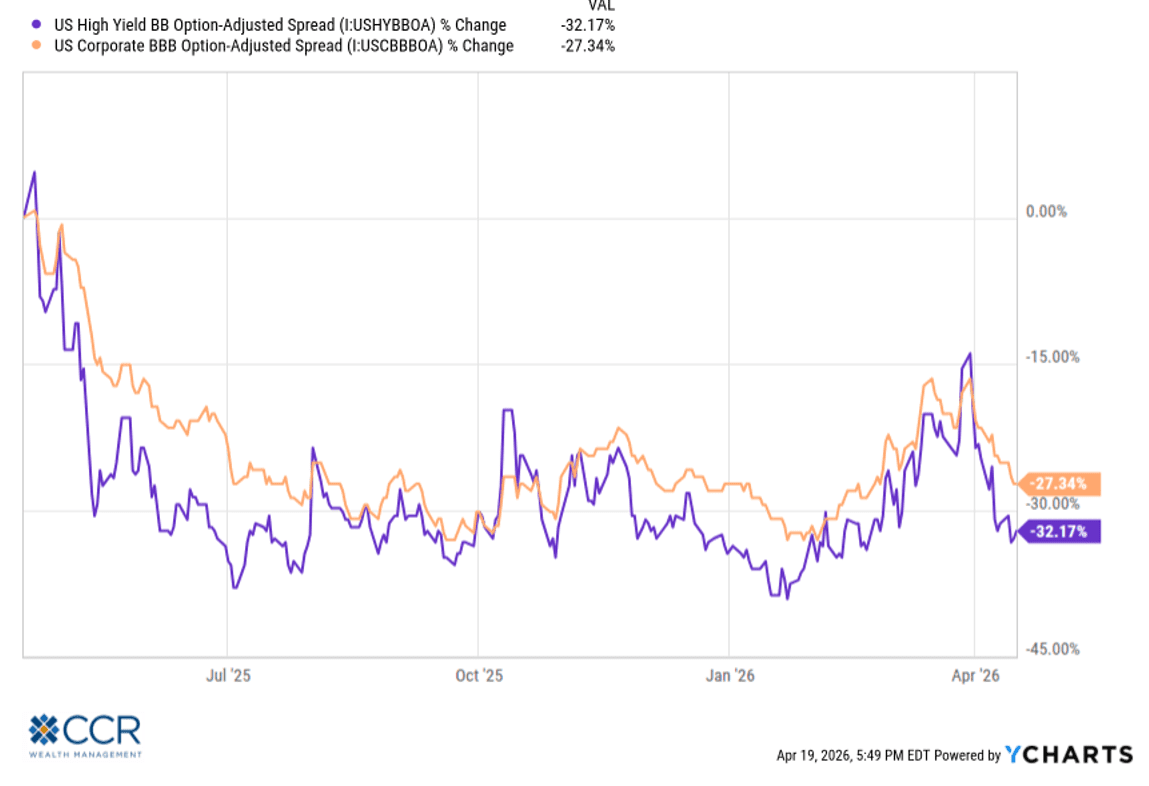
We can recall a day when the software industry was universally considered to be highly profitable with low capital requirements—and relatively low debt. In other words, software was a “cash cow”. But a confluence of factors has changed the math. These factors range from the cheap interest rates of the 2010’s, leverage buyouts also during the 2010’s, a rush of non-bank (i.e. “private”) lenders into the sector attracted by its free cashflow characteristics, pressures caused by the brain-drain (sometimes referred to as the “great resignation”) in the post-pandemic era, and the rising interest rates of the last 4 years. Costs have risen significantly across the sector, with many formerly clean balance sheets now laden with debt—much of it “private” (meaning it is generally not traded on open markets like regular bonds, and often it is structured as “loans”—bypassing normal credit scrutiny an investor might pay before buying bond debt). The sector is facing as much as $40 billion of this debt maturing in 2028—much of it “B” rated or equivalent (junk), at a time when many software firms are facing challenges to their business models from AI, in addition to the rising costs already mentioned. It could be said that something similar happened around 2015 with the oil & gas sector’s marriage to the high-yield sector. Ultimately, a washout occurred, and high-yield investors took a significant hit. The concern is that a “flu” in the private debt sector could be contagious and transmit to the public sector. Thus far, we can confirm that while we have seen a general “hiccup” in higher credit spreads in the first quarter, spreads have recently declined again, signaling that the canary in the coal mine is still chirping away.
Summing everything up in a tidy package is difficult these days—with a few likely Truth Social missives and other headlines standing between this Outlook getting through compliance and its landing in your inbox. Internally, we have reminded CCR Wealth Management advisors that US equity markets have had three extraordinary, high double-digit returns over the last three years. Reversion to the mean is a real thing—and investors should calibrate their expectations accordingly. We cannot predict the outcome of events in the Gulf, but all signs point to higher inflation pressures ahead. We have deliberately highlighted the benefits of true diversification in our last several Outlooks—and hope we’ve made the case again. Simplifying “US” versus “non-US” as being a more conservative approach in this environment is perhaps reflexive, but in our view is an oversimplification. Higher inflation expectations will prevent lower interest rate yields—regardless of what the Fed does—and this could continue to impact the upward trajectory the “growth” crowd seems to perpetually expect. It would be good for “growth” investors to become acquainted with other areas of the market.
Lastly, we are reminded of a humorous beer commercial featuring “the Most Interesting Man in the World”, whose tagline is: “Stay thirsty, my friends”.
Our is: “Stay liquid, my friends”.
Disclosures:
MSCI Germany Index (MSDE) is a free float–adjusted, market capitalization–weighted index designed to measure the performance of large- and mid-capitalization stocks of companies domiciled in Germany.
MSCI France Index (MSFR) is a free float–adjusted, market capitalization–weighted index designed to represent the performance of large- and mid-capitalization companies in the French equity market.
MSCI United Kingdom Index (MSUK) is a free float–adjusted, market capitalization–weighted index designed to measure the performance of large- and mid-cap companies in the United Kingdom.
MSCI Japan Index (MSJP) is a free float–adjusted, market capitalization–weighted index designed to measure the performance of large- and mid-cap Japanese equities.
MSCI China Index (MSCN) is a free float–adjusted, market capitalization–weighted index designed to measure the performance of large- and mid-cap Chinese equities, including China A-shares, H-shares, B-shares, Red Chips, P-Chips, and foreign listings.
MSCI Australia Index (MSAU) is a free float–adjusted, market capitalization–weighted index designed to measure the performance of large- and mid-cap companies in the Australian equity market.
MSCI Emerging Markets Index is a free float–adjusted, market capitalization–weighted index designed to measure equity market performance across emerging market countries globally.
MSCI Brazil Index is a free float–adjusted, market capitalization–weighted index designed to measure the performance of large- and mid-cap companies in the Brazilian equity market.
MSCI Korea Index (MSKR) is a free float–adjusted, market capitalization–weighted index designed to measure the performance of large- and mid-cap South Korean equities.
MSCI Taiwan Index (MSTW) is a free float–adjusted, market capitalization–weighted index designed to measure the performance of large- and mid-cap Taiwanese equities.
Dow Jones U.S. Software Index (DJUSSW) is designed to measure the performance of U.S. companies in the software industry, as classified by Dow Jones Indices’ proprietary industry classification system.
PHLX Semiconductor Sector Index (SOX) is a modified market capitalization–weighted index designed to track the performance of companies primarily involved in the design, distribution, manufacture, and sale of semiconductors.
MSCI ACWI Information Technology Index (MSACWIIFT) is a free float–adjusted, market capitalization–weighted index designed to measure the performance of information technology sector companies across both developed and emerging markets globally.
Russell 1000® Value Index (RLV) measures the performance of large-cap U.S. equities that exhibit value characteristics, as defined by Russell’s style methodology, which considers variables such as book-to-price ratio, earnings growth, and sales growth.
Russell 1000® Growth Index (RLG) measures the performance of large-cap U.S. equities that exhibit growth characteristics, as defined by Russell’s style methodology.
U.S. High Yield BB Option-Adjusted Spread (I: USHYBBOA) measures the option-adjusted spread of U.S. dollar–denominated, BB-rated high yield corporate bonds relative to comparable-duration U.S. Treasury securities.
U.S. Corporate BBB Option-Adjusted Spread (I: USCBBBOA) measures the option-adjusted spread of U.S. dollar–denominated, investment-grade corporate bonds rated BBB relative to comparable-duration U.S. Treasury securities.
Follow us on social media for more timely content delivered directly to your news feed!